

Jump to:
Bird flu warning
Due to the Avian Influenza Prevention Zone (AIPZ) currently in place across the UK, don’t touch or handle sick or dead birds. If you have to, thoroughly wash your hands immediately afterwards, keeping them away from your face or food.
Find out more about bird fluWhat is an egg laying hen?
Egg laying hens are adult female chickens bred specifically to produce eggs. Hens can lay an average of 200 to 300 eggs per year and they’ll spend their entire lives producing eggs in one of several systems; battery or enriched cages, barn systems or free-range and organic.
When do chickens start laying eggs
Chickens start laying eggs when they’re between four to six months old. The hens will continue to lay eggs almost every day for the rest of their lives. Usually, chickens can live from five to 10 years if allowed to live naturally – but laying hens often don’t make it to two years, as they’re killed once egg production slows.
How long are laying hens kept?
On average, laying hens are usually kept until they’re around 70 to 100 weeks old (18 months to two years), which is when egg quantity or quality begins to decline. When this happens, they’re slaughtered and replaced.
However, if any male chicks of laying hen breeds hatch, they’re killed when they’re one day old, as the farming industry has no ‘use’ for them. They can’t lay eggs, nor will they produce as much meat as broiler chickens breeds, so raising them is deemed unprofitable.
Did you know?
Hen's eggshells are the same colour as their earlobes.
Dark earlobes usually means brown eggs, and hens with lighter lobes lay white eggs.
Laying hen breeds
Laying hens are selectively bred for their ability to produce high quantities of eggs. Certain breeds are for egg production, while others, like meat chickens, are bred for their meat. In more recent years, ‘dual-purpose’ breeds are being reared for both eggs and meat. Several farms, welfare experts and researchers in the UK are currently trialling the feasibility of dual-purpose breeding systems. We support this as an alternative to male chick culling, as male laying hen chicks will then be reared for their meat rather than killed at one day old.

The UK’s best breeds of laying hens for commercial egg production are often brown hen breeds but also include hens that lay white eggs, including:
- Hyline Browns
- Lohmann Browns
- Dekalb Whites



Laying hen production systems
Laying hens will spend their lives producing eggs in different egg production systems; as battery hens stuck inside enriched battery cages, free-range hens with the freedom to roam, or hens in barn systems. Find out more about each type below.
The proportion of eggs produced in the different systems in the first quarter of 2026 in the UK was*:
- 14% in enriched cages
- 8% in barn systems
- 76% in free-range systems
*Figures rounded up/down.
Battery and enriched caged hens
Hens kept in large sheds inside cramped cages are known as battery caged hens. Battery cages – or barren battery cages – are enclosed wire cages, less than the size of an A4 piece of paper each, housing four to five hens. A single battery system can contain rows upon rows of cages stacked on top of one another.
Traditional battery cages were banned throughout Europe in 2012 – replaced by ‘enriched’ cages. Enriched cages – also called furnished or colony cages – were developed with the intention to improve laying hens’ quality of life. They require:
- A nesting area
- Perches
- Litter
- More space
However, these furnished enriched cages hold around 90 hens and don’t actually provide any meaningful enrichment – with dust bathing or objects to peck (like straw bales).
These cage systems – both traditional and enriched – limit the hens’ ability to move around and perform natural behaviours. This can cause the birds to suffer high levels of stress and frustration. Like all animals, hens need to be active and perform natural behaviours, such as walking, nesting, perching, stretching their wings, dustbathing, scratching the ground, and foraging.
Barn hens
Hens in barn systems have freedom and space to move around inside a building – typically a barn. Perches are provided for roosting, as well as material to dustbathe and forage in, and nest boxes, which are private spaces for hens to lay their eggs. Some systems are 'multi-tier', providing additional levels to use above the ground.
This non-cage alternative improves hen welfare. It provides enrichment, larger spaces and higher standards of living, allowing hens to express their natural instincts and generally enjoy their surroundings.

Free-range and organic hens
Free-range hens have more freedom. According to UK law, to be officially classed as free-range, hens must have:
- Outdoor access: The range must be accessible to the hens continuously during daytime and provide at least 4m² per hen at all times (however, hens have to be kept indoors during outbreaks of bird flu, while their eggs will remain labelled as free-range).
- Shade and shelter: The range should be mainly covered in vegetation and have at least four shelters per hectare.
- Litter: Used as bedding, for droppings and for scratching, exploring and dustbathing, this must cover a minimum of a third of the ground.
Most free-range hens on commercial farms live in buildings like the barn system, but have access to the outside through openings called 'popholes'.
In general, organic hens are part of a much smaller flock; up to 3,000 hens, compared to a maximum of 16,000 free-range hens. Another comparison is beak trimming (removing the tip of the beak to prevent painful pecking) which is banned for organic hens, but available for free-range. Organic hens are also fed a GM-free diet, meaning the grains they eat aren’t genetically modified.
These free-range and organic systems differ from indoor systems as they allow chickens the freedom to move and express their natural behaviours. All hens should have the opportunity to roam and follow their instincts, which is why organic free-range conditions are ideal. However, all non-cage systems that are well-designed and well-managed – with perches, nest boxes, floor litter and enrichment objects – provide a much higher standard of welfare than cages.
Since 2004, the law has required all eggs and egg boxes to be labelled according to the method of production – either eggs from caged hens, barn, free-range or organic. The vast majority of free-range eggs in the UK come from hens inspected to these standards through the RSPCA Assured scheme. Find out how to choose cage-free eggs below.

Higher welfare for laying hens
Every animal deserves kindness, access to food and water, freedom to move, and the chance to express their natural behaviours – which is why we’re working harder than ever to ensure laying hens get the same. As naturally inquisitive animals, hens like to roam and forage, which benefits them both physically and mentally. With no room to move, they’re unable to do what comes naturally.
Their natural behaviours:
- Dustbathing: This is very important for their physical and mental wellbeing. It helps them remove parasites, keeps their skin and feathers in good condition and their body temperature comfortable.
- Perching: Hens like to roost on perches at night with their flockmates. In the wild, this behaviour protects them from predators and also helps to conserve body heat.
- Nesting: Hens look for a suitable, enclosed nesting site before starting their pre-laying behaviour and finally laying an egg.
- Comfort and grooming: These behaviours include feather ruffling, head scratching, body shaking, wing stretching and flapping.
- Exploring: Hens like to explore their surroundings, for example, by pecking at objects and scratching at the ground to unearth things in the soil.
- Vocalisation: When hens aren't provided with access to something they need, such as a nest site or appropriate dustbathing material, they often make more noise out of frustration. Sometimes they produce a specific sound known as a 'gakel-call'. Hens also vocalise to communicate with their flockmates, to socialise and as a warning.
Their harsh reality
Some hens are kept in cages: This tiny space restricts their ability to move, perch, nest, scratch, explore, dustbathe, forage and generally feel comfortable. They can’t even stretch out their wings fully.
I love watching hens dustbathe when I visit our members’ farms. It’s the equivalent of a spa day for them, and helps them keep both clean and cool.
What we’re doing to help
We want to see all laying hens kept in well-managed, free-range or barn systems. From rearing to transportation to more humane methods of slaughter, we’re fighting on their behalf to improve their quality of life at every stage. Here are some of the ways we’re working for hens:
- Pushing for stronger laws: We take every opportunity to stress the need to ban all cages, highlighting the advantages of keeping hens in well-managed, higher-welfare systems such as barn and free-range.
- Campaigning work: We've been campaigning for many years to have eggs clearly labelled (and products containing eggs), allowing consumers to make an informed choice about which production system they support when they buy eggs.
- Using scientific research to improve welfare: Scientific evidence is important when we're trying to find practical solutions to laying hen welfare problems, which can be very complex.
- Developing RSPCA welfare standards: We’ve developed detailed welfare standards for laying hens and pullets (young chickens), which contain requirements to ensure that higher standards of animal welfare are met at all stages of the hens' lives. Our RSPCA standards don't allow hens to be kept in cages and are much more detailed and stricter than minimum legal requirements. These standards have to be met on all RSPCA Assured members’ farms.


Feather pecking
When chickens feel unwell, stressed or unable to act on natural instincts, they may engage in feather pecking.
Feather pecking is when hens peck, pluck and pull at the feathers of other hens, sometimes leading to serious injuries and even cannibalism. It can affect hens in any system and outbreaks can happen suddenly.
Feather pecking in hens is believed to be a redirected foraging behaviour. The reasons behind it can vary, but include:
- Environment: Factors such as temperature, lighting and overcrowding can trigger pecking.
- Breed: Certain breeds, such as leghorns and Mediterranean breeds, are prone to feather pecking.
- Nutritional deficiencies: Lack of nutritional foods can lead to pecking as they’re attempting to replace the missing nutrients.
- Poor health and diseases: Can lead to an increase of stress and feather pecking.
- Pecking order: Hierarchies within the flock can result in bullying and injuries.
- Sudden changes: Such as changes to their feed or environment, which can cause stress channelled through feather pecking.
Beak trimming
To prevent feather pecking from occurring, chickens may undergo a beak trimming procedure.
Beak trimming in laying hens, sometimes called 'beak tipping', is carried out on day-old chicks to prevent the tip from growing into a sharp point, to reduce the risk of feather pecking injuries.
In the UK, beak trimming may only be carried out using infra-red technology, which exposes the beak to infrared light, gradually breaking down the tissue, except under specific circumstances. In many European countries, like the Netherlands, this practice is banned.
Sadly, beak trimming is the main method of reducing these injuries in laying hens. We continue to work with all sectors of the industry, including rearing, breeding and research scientists, to help find an alternative that prioritises hen welfare, so we can achieve a ban on routine beak trimming as soon as possible.
How to choose cage-free eggs
Choosing eggs from cage-free hens is a great way to show your commitment to chicken welfare, and hopefully discourage the use of caged systems in the future. The cost of choosing eggs from higher-welfare systems compared to battery cages can be a matter of a few pennies – a small price to pay for a better life for hens.
How you can help
The best way to ensure you’re choosing high-welfare eggs is to look for the RSPCA Assured label on egg boxes. RSPCA Assured eggs are from hens reared on farms that are regularly assessed to ensure they’re meeting our strict RSPCA welfare standards. They’re never kept in cages.
RSPCA Assured is the RSPCA’s ethical food label and farm assurance scheme. Its expert assessors check that more than 4,000 farms and businesses are meeting the RSPCA’s strict welfare standards. If more consumers insist on higher-welfare products, more supermarkets will want to stock them, which will encourage more farmers, hauliers and abattoirs to improve their practices and ultimately more farm animals will benefit.
The best way to ensure you’re choosing high-welfare eggs is to look for the RSPCA Assured label on egg boxes. RSPCA Assured eggs are from hens reared on farms that are regularly assessed to ensure they’re meeting our strict RSPCA welfare standards. They’re never kept in cages.
Egg box labels
The law requires all eggs and egg boxes to state how the hens were kept: free-range, barn, organic or cage. These terms – and particularly 'eggs from caged hens' – are sometimes in small print on the back of the box, so look carefully. Egg boxes labelled 'Farm Fresh' or 'Healthy Living' can still be from caged hens, so always check for the method-of-production label.
Check the egg
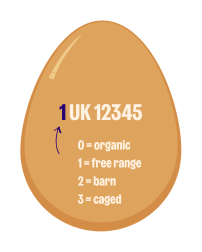
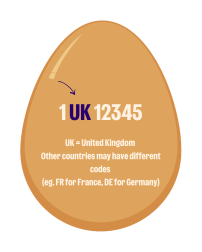
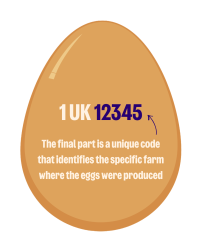
Loose eggs have to be stamped with a code. The first number tells you how the hens were kept:
- 0 means organic
- 1 means free-range
- 2 means barn
- 3 means cage
Eggs as ingredients
Eggs are used as ingredients in prepared food, including ice-cream, mayonnaise, cakes, quiches and sandwiches. Legally, none of these have to be labelled with how the hens were kept. However, foods made with cage-free eggs will often feature the information clearly on the packaging or in the ingredients list. If the labelling isn’t clear, check with the retailer or manufacturer.
While consumers are buying more boxes of free-range and barn eggs, a large proportion of eggs used as ingredients – in products such as mayonnaise, cakes and sandwiches – are still from hens kept in cages.
You have the power to improve the lives of hens by only buying cage-free eggs.
Where to find cage-free eggs
You can find supermarkets that stock RSPCA Assured labelled eggs here. If your supermarket doesn't stock RSPCA Assured labelled eggs, you can let them know you'd like to buy them here.
Many supermarkets offer own-brand products made from cage-free eggs, such as Marks & Spencer, Waitrose, Sainsbury’s and Co-op.


